Hushpen
I built Hushpen to keep writing close to speaking. Hold a key, say the thought, and let the words land in your app.
It started as ASR Pro, an Electron app. Hushpen is the rewrite: a native Rust app for Mac and Linux, with local speech models and no telemetry. This post covers the ideas behind it, the app itself, and the engineering choices under the hood.
## Quiet by design. Native by default.
Tools like Wispr Flow showed me how good dictation can feel: hold a key, talk, and clean text appears where you type. I wanted that feeling in an app that is open source and local first.
Your audio and text never leave the machine unless you choose an endpoint yourself.
The promise in the README
The look comes from one design file, `DESIGN.md`, and the code follows it to the pixel. Four ideas from it shape every screen.
### Feels like a Mac app System font, groups and rows like System Settings, and one blue accent. No color for decoration.
**Hushpen**Home
One line, 26 px from the top
### A HUD, not a window The flow bar floats over other apps, so it stays a dark capsule in Light and Dark. It never takes focus.
Cancelled
4 + 20 + 8 + text + 8 + 20 + 4
### Private by default Speech is transcribed on your computer. The network is used for three things only.
**Model downloads**Only when you start one
**Update check**Off by default
**Your own endpoint**Only if you set one
Everything else: nothing
### Quiet motion Short moves that show where things come from. One ease-out curve, and it never bounces.
Fast**90 ms**
Slide**110 ms**
Base**130 ms**
Travel**4 px**
Reduce Motion: no moves
## A little bar. A complete thought.
The flow bar follows speech from listening to pasted text. It keeps Undo close for four seconds, and lets you recover words after cancel.
Click the capsule to move to the next state.
Listening
## Say it naturally. Keep the good parts.
Rules remove fillers, repeats, and spoken corrections. A local cleanup model can shape the result for a message, an email, or notes.
Command Mode edits selected text by voice.
### Rule cleanup Fillers and take-backs go. The meaning stays.
Heard
meet at 3, no wait, 4
Pasted
Meet at 4.
### Any key you like Hold, tap, or double-tap. Esc cancels recording.
⌥optionesc
Hold to talk.Double-tap for hands-free.Esc cancels recording.
### Local AI cleanup A profile for where it goes. Try the four profiles.
General Message Email Notes
Heardhi team the docs the tests and the numbers all look good can we ship friday thanks
Hi team, the docs, the tests, and the numbers all look good. Can we ship Friday? Thanks.
Hi team, docs, tests, and numbers all look good. Ship Friday? Thanks
Hi team,
The docs, tests, and numbers all look good. Can we ship Friday?
Thanks
All look good:
- The docs
- The tests
- The numbers
Can we ship Friday?
### Command Mode Select text. Say the change. Keep writing.
thanks for the update, i will look at it soon
### History Find what you said. Export TXT, SRT, VTT, or JSON.
**Send the draft to Priya after lunch.**Mail · 0:06
**Meet at 4.**Messages · 0:03
**Welcome to the team call.**Read aloud · Kokoro · Heart
TXTSRTVTTJSON
### Your dictionary Names and terms, your way. Try the word pack switches.
**Indian names**153 words
**Indian places**155 words
**Hinglish words**98 words
**Tech terms**221 words
### Manual transcription Drop your audio files. Work through the queue.
Drop audio files here
**Interview.wav**Waiting
### Read aloud Pick a voice in Kokoro. Mix two voices together.
Kokoro · Mix
Heart with **30%** Adam
## See every screen. Light or Dark.
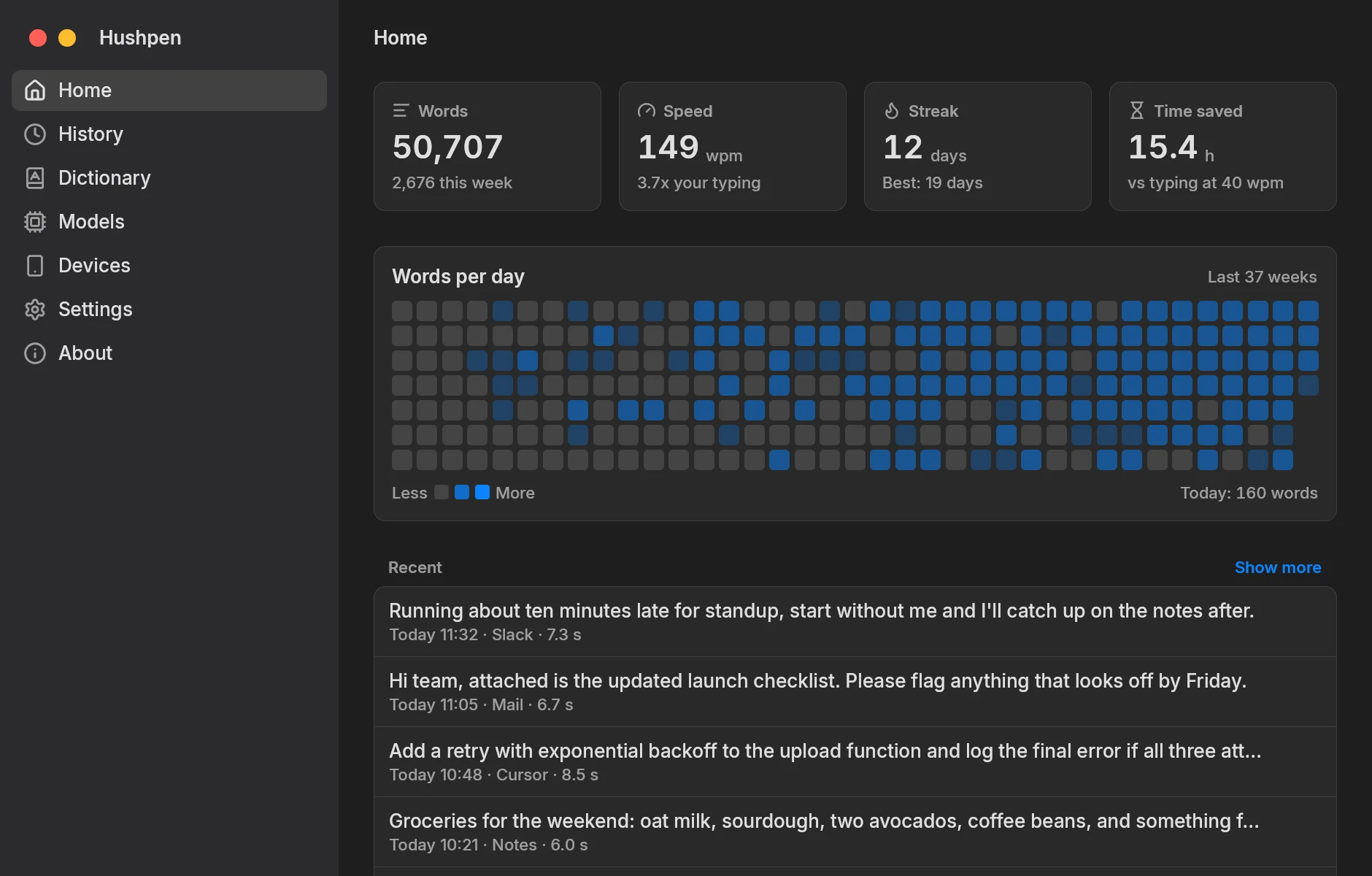
The app uses native sizes and familiar controls. Browse the real captures, including model details, cleanup profiles, and first-run setup.
Choose a view and a screen to compare both appearances.
Home Files Models History Dictionary Read aloud Settings About
Light Dark
## Under the hood. The choices behind it.
Hushpen 2.0 is Rust from the window to the engines. Every binding choice is a numbered decision in `specs/decisions.md`, so the reason stays next to the code. These are the ones I am proudest of.
Rust crates
10
Programs in every package
4
Written decisions
44
Pixel test baselines
136
D-05Interface
### Native Rust, no web view
The first version was Electron. For 2.0 I rewrote everything in Rust. The window is drawn on the GPU with GPUI, the interface framework of the Zed editor, and every dependency is pinned to an exact `=` version.
No web view and no Python sidecar.
Decision D-05
D-06Build
### Four programs, because of one library
whisper.cpp and llama.cpp each bring their own copy of ggml, the math library under both. Linked into one binary, the two copies give no error. One just replaces the other. So speech, cleanup, and voices each run in their own program.
Window**hushpen**GPUI interface, flow bar, shortcuts, paste
Speech**hushpen-asr**whisper.cpp · Parakeet and Whisper · Metal on macOS
Cleanup**hushpen-llm**llama.cpp · S1-mini and Qwen3.5 2B
Voices**hushpen-tts**sherpa-onnx with dlopen · Kokoro and Chatterbox
A gate check reads `cargo tree` for each program and fails when a library crosses over:
```
// xtask/src/two_binary.rs
Rule {
package: LLM,
present: &["llama-cpp-sys-2"],
absent: &["whisper-rs-sys", "whisper-rs", "hushpen-engine", APP, TTS],
},
```
D-40Models
### Models picked by measurement
I tested the speech models on 77 of my own dictations in Indian and British English. Parakeet v3 made half the errors of the next model, so it is the default. The Whisper models stay for other languages, translation, and older computers.
Word error rate on 77 dictations · lower is better
Parakeet v3 Q4_4.14%_
Whisper Large v3 Turbo Q5_8.44%_
Whisper Small Q5_11.01%_
Whisper Base Q5_11.97%_
Each download is pinned to a Hugging Face revision, with its exact size and SHA-256. Before it starts, the app checks the free disk space and keeps 10% to spare.
```
// assets/models.json
{
"id": "parakeet-v3-q4_k",
"bytes": 415611879,
"sha256": "8b205b8b39c6535e153de6fb11c51db46125d45c4f16ba496fe41a0fe71b885e",
"url": "https://huggingface.co/ggml-org/parakeet-GGUF/resolve/35156454d1a3…",
"license": "CC-BY-4.0"
}
```
D-43Dictation
### The whole clip beats streaming
Transcribing while you speak sounds faster. I measured it on the same 77 dictations, against a limit of 0.3 points of word error rate. The gain was small and the risk was not, so Hushpen transcribes the whole clip after you stop.
**329 ms**saved by streaming with Parakeet
**0.29 pts**more word errors, and up to 0.85 at 95% confidence, past the 0.3 limit
**Rejected**Whisper Turbo also lost 0.36 points to save 937 ms
Before recognition, the bundled Silero model cuts the silence, offline. Long pauses and quiet noise give no made-up words.
D-15Cleanup
### Cleanup in two layers
Rules run first. They are on by default and work offline: fillers, repeats, spoken punctuation, and take-backs like "X, no wait, Y". AI cleanup is opt-in, with a local model of at most 1.5 GB or an endpoint you set. A timeout or a failed output check falls back to the rule text, so a broken answer does not reach your app.
**484 MB**S1-mini by Superwhisper, in place of a 3.1 GB Gemma download
One function, `cleanup_prompt`, builds both what the Prompt sheet shows and what is sent.
Decision D-15
D-38Memory
### Memory that steps aside
Models are big, and most of the day you are not talking. Each worker can keep its model, page it out, or unload it when idle. On Linux, page out gives the weights back to the kernel, and the model stays loaded. macOS compresses idle memory by itself, so there the model stays.
**323 to 178 MiB**a kept Whisper Base model while idle on macOS
**1 at a time**a model switch frees the old model before the next one loads
```
// crates/hushpen-engine/src/pageout.rs
// SAFETY: MADV_PAGEOUT only reclaims pages and keeps their contents (madvise(2)), and
// `track` took each page-aligned range from this process's own mappings.
if unsafe { madvise(range.start as *mut c_void, range.len(), MADV_PAGEOUT) } != 0 {
return Err(std::io::Error::last_os_error());
}
```
D-28Voices
### Voices on ONNX, the hard way
Read aloud runs Kokoro and Chatterbox on ONNX Runtime in the third worker. Getting it stable taught me five things.
1. **CoreML crashes it.** The CoreML provider aborts the process on Kokoro's dynamic shapes, with a C++ exception that cannot be caught. Kokoro runs on the CPU.
2. **Never unload the library.** ONNX Runtime's exit-time destructors raced the unload on Linux and crashed an otherwise clean shutdown.
3. **No downloads at build time.** The sherpa-onnx-sys crate was rejected, because its build script downloads the library. The worker opens pinned, checksummed libraries with dlopen.
4. **No GPL data.** sherpa-onnx 2.0.0 has no espeak-ng, so the worker turns text into phonemes itself. Words outside the lexicon are still spoken.
5. **A voice mix is math.** Two Kokoro voices blend as a weighted average of their [510, 1, 256] style blocks.
**0.5**Kokoro real-time factor on an Apple M4 Pro: 10 s of speech in about 5 s
**1.2 s**to the first audio with Chatterbox Turbo, in a voice cloned from 5 to 20 s of speech
D-34Shortcuts
### Any key, even Cmd+Tab
A media key, F13, Caps Lock, or both Ctrl keys together can all be a shortcut. A shortcut that another app holds is saved anyway, shows who uses it, and goes live once it is free. While Cmd+Tab is your shortcut, Hushpen turns off the macOS app switcher. If the app crashes, a small guard process sees its pipe close and turns the switcher back on.
Hushpen keeps no list of allowed chords: any keys the system reports, held together, are a shortcut.
Decision D-34
D-29Linux
### A Linux window that reads the room
With a compositor, the Linux window matches the Mac one: 10 px corners, a hairline edge, and a see-through sidebar that KWin blurs. Without one, a transparent pixel renders black, so the window stays square and solid. Hushpen checks once a second and switches live.
Compositor found
No compositor
D-09Quality
### One gate, pixel tests, and real runs
One command, `cargo xtask gate`, runs every check, and warnings are errors. Pixel tests render the views offscreen in Light and Dark with Reduce Motion on, so every baseline is a settled frame. Linux end-to-end tests drive the debug app in containers with Xvfb, openbox, PulseAudio, and Mesa.
1. fmt
2. clippy
3. test
4. cargo deny
5. two-binary
6. net-audit
The test hook that drives the app can never ship. A release build with it does not compile:
```
// crates/hushpen-testhook/src/lib.rs
#[cfg(all(feature = "guard", not(debug_assertions)))]
compile_error!(
"the test hook is for debug builds only: build without the test-automation feature, \
or without --release"
);
```
The app process uses about 15 MB after a day. The separate speech engine holds the model, about 400 MB with Parakeet loaded.
Hushpen 2.3.3 is free and open source under AGPL-3.0-or-later, for macOS 13 or later on Apple silicon and Linux x64 and arm64 on X11.
[Download Hushpen](https://github.com/surajmandalcell/hushpen/releases/tag/v2.3.3) [Read the source](https://github.com/surajmandalcell/hushpen)